A calming bedtime routine for anxious kids (worries, the dark and monsters)
Why worries and fears show up at bedtime, a calming bedtime routine for an anxious child, simple breathing and relaxation tricks, what to do about fear of the dark and monsters, and when to talk to a pediatrician.
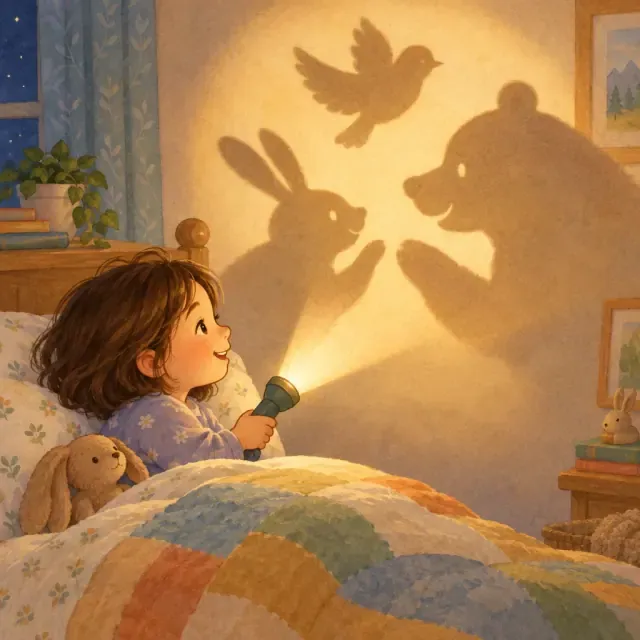
All day, your child is busy. Then the lights go down, the house goes quiet, you leave the room, and every worry they didn’t have time for comes out at once. Is there something in the closet? What if I have a bad dream? What if nobody plays with me tomorrow?
Bedtime worries are very common, and a calm, predictable routine is one of the best things you can give an anxious child. Here’s why worries pile up at night, a routine built to soothe them, a few relaxation tricks that children actually like, and what to do about the dark, monsters and noises.
Why worries come out at bedtime
- It’s the first quiet moment of the day. Nothing is competing for their attention anymore.
- The dark makes things harder to check. A coat on a hook becomes a shape; a creak becomes a footstep.
- It’s a separation. You’re leaving, and for a young child, that can feel big.
- Imagination is growing. The same imagination that invents dragons and secret kingdoms can invent something under the bed. Fears of the dark, monsters and noises are especially common in the preschool and early school years, and most children grow out of them.
None of this means anything is wrong. It means your child needs a little more help winding down than a long day leaves room for.
A calming bedtime routine, step by step
The idea is to make the evening more predictable and less stimulating as it goes on, and to deal with worries before lights-out, not at it.
- Worry time, well before bed (10 to 15 minutes). Not during the bedtime routine: before dinner or straight after works well. Sit together and let them tell you everything that’s bothering them. Write the worries down, or let them draw them, and put the paper in a box or a drawer. “They’ll wait there until tomorrow.” Then move on.
- Screens off, an hour before bed. The American Academy of Pediatrics advises avoiding screens in the hour before bedtime. For an anxious child, that also means no exciting shows or games to replay in their head.
- Warm bath or shower, lights dimmed. Lower the lights around the house as you go.
- Pajamas, teeth, a last drink, the bathroom. Everything they might ask for later, done now.
- A calm story. Choose something gentle, funny or cozy, not suspenseful. Stories where a character is brave in a small way, and everything turns out fine, can be a quiet comfort.
- A relaxation game in bed (5 minutes). See below.
- The same goodnight words. Something they can count on: “I love you. I’ll see you in the morning. You’re safe.”
- A check-in promise. “I’ll come back and check on you in five minutes.” Then do it, every time. Knowing you’ll return makes it easier to let you go.
Keep the routine the same every night. Predictability is calming in itself.
Relaxation tricks kids actually like
Belly breathing
Lie a stuffed animal on their tummy and ask them to make it rise slowly as they breathe in, and sink as they breathe out. Or: “Smell the flower” (breathe in through the nose) and “blow out the candle” (breathe out slowly through the mouth). Five slow breaths is plenty.
Squeeze and let go
Starting at the toes, squeeze a part of the body tight for a few seconds, then let it go floppy. “Squeeze your toes like you’re picking up a pencil… and let go.” Work up to the fists (“squeeze a lemon”) and the face (“scrunch your nose like a bunny”). It’s called progressive muscle relaxation, and children tend to find it funny, which helps too.
A favorite place
Ask them to describe, in detail, a place where they feel happy and safe: the beach, Grandma’s kitchen, a tree house they’ve invented. What can they hear? What does it smell like? Talking a child through it slowly is a lovely last step before you leave.
Afraid of the dark
- Take it seriously, but keep it short. “I can see you’re scared. You’re safe. I’m right down the hall.” Long reassurances at lights-out can make the fear feel bigger.
- A dim night-light. It’s fine; HealthyChildren.org suggests one in the hall near their door, which gives comfort with very little light. Keep it dim, and choose a warm glow over a bright, blue-white one.
- Let them be in charge of the light. A small flashlight by the bed gives them a way to check for themselves.
- Practice the dark in the daytime. Flashlight games, shadow puppets, a blanket-fort picnic. Making the dark playful in the day takes some of the fear out of it at night.
- Praise brave steps, but don’t push. The AAP’s advice is not to pressure a child into being brave. Staying in bed a little longer than last night counts.
What about monsters (and monster spray)?
Lots of families make “monster spray” (water in a spray bottle with a fun label) and spritz the room at bedtime. Some children love it. If you try it, we’d suggest making it a “sweet dreams spray” or “sleepy spray”: a calming ritual, rather than a weapon against something that has to be fought.
Either way, a calm, matter-of-fact tone helps most. “Monsters are only in stories. Your room is just your room. Let’s look together.” Then do one quick check, and stop. Take the fear seriously without dwelling on it: lots of checking can make it feel bigger.
Stories can help, on a calm day
Stories are one of the gentlest ways to talk about fears. A story about a little bear who’s scared of the dark lets a child think about their own fear from a safe distance, and to rehearse being brave. Read them on a calm afternoon, or early in the evening, so bedtime itself stays cozy.
There’s even a little research behind this. In small studies, children aged about 3 to 8 with nighttime fears improved after their parents read them a story-based program, Uncle Lightfoot, Flip That Switch, together with simple bravery games.
We make Branchlings, where your child is the hero of their own stories and chooses what happens at every fork. It has stories for big feelings, including Brave in the Dark, Wibbly Worries and When Feelings Get Too Big. Grown-ups can choose how exciting stories get (Extra cozy, Gentle or Adventurous) and leave out topics entirely, like the dark, storms or spiders. Around bedtime, stories turn calm and wind down to goodnight.
It’s still a screen, so the same advice applies: read it earlier in the evening, and keep the last part of bedtime for a paper book, your voice and the routine above. For more on stories that help with feelings, see our guide to the best story apps for big feelings.
When to talk to a pediatrician
Most bedtime fears fade with time and a steady routine. Talk to your child’s doctor if:
- fears or worries are getting in the way of everyday life, like school, friends, activities or sleeping on their own;
- your child is regularly unable to fall asleep for a long time, or wakes in a panic;
- the anxiety seems to be getting worse over several weeks, not better;
- or something has changed suddenly, like a stressful event, and your child isn’t recovering.
You know your child best. If your gut says it’s more than a phase, ask.
More on bedtime: bedtime routine for 3 year olds, for 4 and 5 year olds and for 8 year olds.
Sources: HealthyChildren.org, fears and phobias in children, helping your child manage anxiety and Sleep and Health; Children’s Hospital of Philadelphia, progressive muscle relaxation; Sheffield Children’s NHS Foundation Trust, sleep and anxiety; Muris et al., nighttime fears in children (2001); Lewis et al., a parent-led treatment for nighttime fears (2015); AAP, Digital Ecosystems, Children, and Adolescents (2026).