First day of kindergarten: how to get your child (and yourself) ready
A practical guide to the first day of kindergarten: what to do in the weeks before, the night before and the morning of, how to handle tears at drop-off, books about starting school, and the questions that actually get answers at pickup.
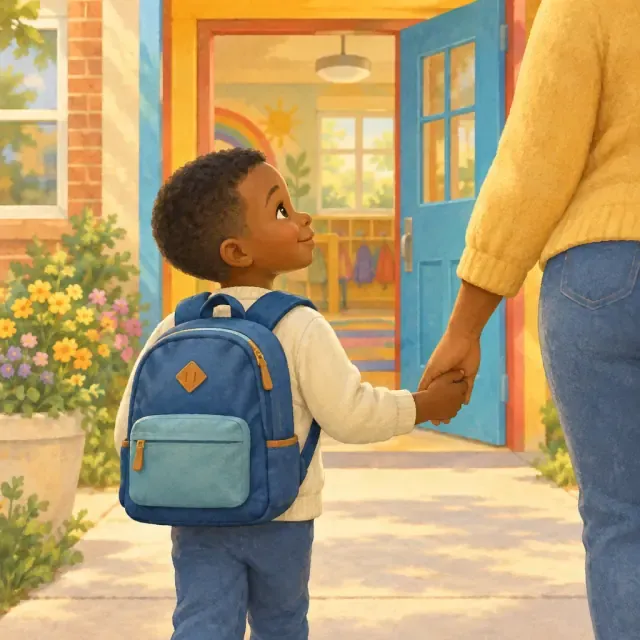
The first day of kindergarten is a big day for a five-year-old, and often a bigger one for their grown-ups. New building, new teacher, new rules, a whole day without you. Some children march in without looking back. Some cling to your leg. Most are somewhere in between, and nearly all of them settle in.
Here’s how to get ready: in the weeks before, the night before, the morning of, and the afternoon after.
In the weeks before
Make the school familiar
- Visit. The American Academy of Pediatrics suggests visiting the school or classroom before the first day. Walk or drive past a few times. Play on the playground on a weekend. If there’s an open house or a chance to meet the teacher, go.
- Talk about the day in detail. Children feel calmer when they know what happens next. Where will they hang their backpack? When is lunch? Who picks them up, and where?
- Play school. Take turns being the teacher and the student. Let a stuffed animal be the nervous new kid, and your child the one who shows them around.
Practice the small, practical things
Much of the stress of the first weeks is little things. Practice them at home:
- opening their lunchbox and every container in it,
- zipping their coat and putting on their shoes,
- using the bathroom on their own and washing their hands,
- saying their full name, and their grown-up’s name,
- asking a grown-up for help (“Excuse me, can you help me open this?”).
Shift bedtime early
Kindergarten mornings are often earlier than preschool or summer ones. A week or two before school starts, move bedtime and wake-up earlier by 10 to 15 minutes every few days until you’re on the school schedule. Our bedtime routine for 4 and 5 year olds has a sample school-night routine.
Read about starting school
Picture books about the first day give children words for what they’re feeling, and a chance to rehearse it from a safe distance. A few favorites:
- The Kissing Hand by Audrey Penn: a little raccoon, a big first day, and a goodbye ritual you can borrow.
- Llama Llama Misses Mama by Anna Dewdney: missing your grown-up, and finding your feet.
- Wemberly Worried by Kevin Henkes: for the child who worries about everything.
- First Day Jitters by Julie Danneberg: a twist ending that makes nervous kids laugh.
- The Night Before Kindergarten by Natasha Wing: a gentle countdown, perfect for the last week.
The night before
- Keep it calm and ordinary. A normal dinner, the usual routine, an early-ish bedtime. Big speeches about how big a day tomorrow is can make it feel bigger.
- Get everything ready together. Clothes laid out, backpack packed and by the door, lunch in the fridge. Let them choose one small thing, like the socks or the lunchbox snack.
- Make room for feelings. “It’s okay to feel excited and nervous at the same time. I felt like that on my first day, too.”
- A story about a brave first day. Something gentle, where the character is nervous and it turns out fine.
The morning of
- Leave plenty of time. Rushing is the enemy. Get up early enough for breakfast and a photo on the doorstep without anyone shouting about shoes.
- Stay calm and upbeat. Children read our faces. If you’re anxious (and many of us are), save it for the car afterwards.
- Have a goodbye ritual. A special handshake, a kiss in the palm (borrowed from The Kissing Hand), a phrase you always say: “Have a brave day. I’ll be here at three.”
- Keep the goodbye short. As the AAP puts it, if you linger, the transition time does too, and so does the anxiety. Say goodbye clearly, hand them to the teacher, and go. Don’t sneak out: it can make the next morning harder, because they’ll worry you might disappear again.
- Tears are normal. Teachers see them every year, and they usually ease as the weeks go by. A small photo of the family or a special trinket in their pocket can help. If you’re worried, ask the teacher to send a quick note later in the morning.
- Praise the brave part. At pickup, notice what they did: “You walked in even though you felt nervous. That was brave.”
After school
Expect a meltdown (it’s a good sign)
Many children hold it together all day at school and fall apart the moment they see you. It’s exhausting to be good, brave and new for six hours. A snack, a quiet hour and not too many questions usually help.
Ask better questions
“How was school?” almost always gets “Fine.” Try something more specific:
- “What made you laugh today?”
- “Who did you sit next to at lunch?”
- “What was the hardest thing today?”
- “If you could be the teacher tomorrow, what would you do?”
Bedtime is often when the real answers come out, in the quiet, once the lights are low.
When to talk to the teacher or pediatrician
Some nervousness, clinginess and tears in the first few weeks are completely normal. The AAP notes that it’s rare for separation anxiety to keep happening every day after the preschool years. Talk to the teacher early, so you’re working together. If your child’s worries are getting bigger rather than smaller after several weeks, if they have stomachaches or headaches every school morning, or if they’re refusing to go, talk to your pediatrician as well.
Where stories help
Stories are one of the gentlest ways to rehearse a big day. We make Branchlings, where your child is the hero of their own story and decides what happens at every fork. It has stories made for this moment, like First Day of School and Starting Daycare, plus stories for big feelings like Wibbly Worries and Feeling Shy. Your child gets to be the one who walks through the door, makes a friend, and comes home proud.
Read it together in the afternoon or early evening, a week or two before the big day, and keep the last story of the night on paper. You can read a sample story to see how it works.
More: a calming bedtime routine for anxious kids and bedtime stories for 5 year olds.
Sources: HealthyChildren.org, back-to-school tips (2026) and easing separation anxiety (2026); Child Mind Institute, back-to-school anxiety and starting elementary school (2026).